
ChatGPT, Gemini, Perplexity and Claude don’t share one index, they don’t search every time you ask them something, and only a minority of what they cite ranks in Google’s top 10. Each AI assistant finds pages its own way. Some of that is documented, some is measured by outside studies, and some is guesswork dressed up as expertise. This guide sticks to the first two and tells you which is which.
I decided to write this because everyone is either selling “how to rank in ChatGPT” right now or theorising about how to measure your AI visibility. And don’t get me started on “how to rank in” and “how to appear in” being used as if they mean the same thing. Ranking is what you can achieve and measure in a search engine. You do not rank in an AI assistant or an AI Overview. You appear!
So before the tactics and the acronyms, here’s how these things actually work.
The short version
If you run a business, or just want the bones of it, here it is:
- They don’t all search the web. ChatGPT searched on roughly 1 in 7 questions in the biggest study so far; Perplexity searches on every one. When they do search, only Gemini uses Google.
- You don’t rank in an AI assistant, you appear. SEO still gets you in the room. It just doesn’t guarantee a seat.
- Ranking well on Google helps, but most of the pages AI assistants cite aren’t in Google’s top 10 for that question.
- An assistant can describe your brand from memory, months out of date and with no link. Make sure what’s out there about you is accurate, and keep reviews current.
- Text that only appears once scripts load can be invisible to AI crawlers. Keep your important content in the page itself.
- Nobody outside these companies knows exactly how they choose sources. Anyone who says otherwise is guessing.
The rest of this post is the evidence.
How many people actually use these things?
People use these assistants a lot. The way people engage with these tools is very personal. This is something I will be looking at in a later post. Back to our current focus. The four companies each count the “how many people” in a different way, which is why the numbers below don’t quite line up.
| ChatGPT | Gemini | Perplexity | Claude | |
|---|---|---|---|---|
| Users, by the company’s own count | 900m+ weekly users in February 2026, and over a billion across OpenAI’s products by the summer | 950m+ monthly users, per Google’s Q2 2026 earnings call | 100m+ monthly users, as reported by the FT in 2026. The last figure from the company itself was 780m queries in May 2025 | Not published |
| Paying users | 50m+ consumer subscribers, February 2026 | Not published | Not published | Not published. Anthropic says paid subscriptions more than doubled in 2026 |
| Rough split | Well over 90% free | Unknown | Unknown | Mostly business and API customers, per Anthropic |
| Share of worldwide web traffic to AI assistants, September 2026 (Similarweb, posted October 2026) | 56% | 25% | 1% | 10% |
Two honest caveats before we begin.
- These numbers aren’t comparable: weekly versus monthly, users versus queries, and Anthropic gives you growth rates instead of totals.
- Web traffic share misses everything that happens inside apps and behind APIs, so it undercounts Gemini on Android and in Workspace, and Claude through its API.
So you can read the table as “ChatGPT is by far the biggest, Gemini a clear second, Claude and Perplexity much smaller consumer products”, not as an official league table.
Like anything to do with AI right now, nobody can agree on the numbers. This article gets as close to the facts as the published data allows. Which means this will more than likely be out of date before the month ends!
Does an AI assistant answer from the web or from memory?
It does both, and it matters which it does. Every model has two ways to answer you.
Answering from memory
During training the model reads a huge amount of text and learns patterns from it. It doesn’t keep copies of the pages, it keeps what it learned, and that knowledge stops at a fixed date called the knowledge cutoff. OpenAI describes its models this way, and Anthropic publishes a cutoff date for each Claude model.
I use Claude and it will tell me that its memory only goes up to a certain date. Which is fine, because then you can ask Claude to go and get an up-to-date answer.
Answering from live search
The assistant runs a web search, reads a handful of pages, and writes its answer from them, usually with links to those pages. Those links are the citations everyone is chasing.
| ChatGPT | Gemini | Perplexity | Claude | |
|---|---|---|---|---|
| Answers from trained memory? | Yes | Yes | Leans on live search, not memory | Yes |
| Publishes a knowledge cutoff? | Yes, on its model pages. OpenAI also explains that the model learns patterns and doesn’t keep copies of pages | Google publishes model cards, but the Gemini app doesn’t tell you which model or cutoff you’re talking to. It fills the gap with Search | No single cutoff. It runs on several underlying models and searches by default | Yes, a cutoff date for each model |
This matters as only retrieval can cite your page. That used to mean a visible live search. Since May 2026, ChatGPT has also been able to drop inline links into an answer with no search activity showing at all, and OpenAI hasn’t explained what those draw on.
The crawler data further down suggests an index built in advance. Either way, an answer from pure memory still carries no link, and what it says about you depends on what it absorbed months ago.
This is why you are hearing SEOs now talking about brand so much. Your brand may already be showing up in answers that came from stored memory, not a live search. So make sure what’s out there about you is accurate and consistent, keep reviews current and respond to them. That isn’t a one-off job. It belongs in your everyday cadence.
How often do they actually search the web?
Less often than you’d think for ChatGPT, almost always for Perplexity, and when it feels like it for Gemini. Claude is the one nobody has properly measured, on this or on most of what follows, so expect some honest blanks in its column. I’d rather show you a blank than make something up.
| ChatGPT | Gemini | Perplexity | Claude | |
|---|---|---|---|---|
| Who decides | The model, per question. You can force a search | The model, per question. No user toggle | Searches by default, on every question. It’s built as a search engine first | The model, when web search is switched on. You can ask it to search or not |
| How often, measured | About 1 in 7 (14.4%) in Ahrefs’ study of 66.6m responses, published October 2026 on August and September data. That was the free, logged-out version, so paid plans likely search more | Not measured directly | Every query | Not measured |
| Shows sources | Usually when it searched. Since May 2026 it can also add inline links with no visible search, and OpenAI hasn’t said what those draw on | Only when it searched. A Sources button appears, otherwise nothing | Always, as footnotes | Only when it searched |
The ChatGPT figure is the one to remember, with one big caveat: it depends what you ask. Comparison questions search far more than general ones. Graphite looked at “best X” style comparison prompts in August 2026 and found a search in 58% of responses, against Ahrefs’ 14% across everything. Graphite also found that tools which force ChatGPT to search, to make tracking easier, skew the picture by about 20 points. Worth knowing before you buy a dashboard.
If your customers ask comparison and buying questions, ChatGPT and Gemini are probably searching. If they ask “what is X”, they’re mostly answering from memory, and you won’t be cited either way.
Next time someone tells you ChatGPT is just Google in a fancy coat, remind them it only searches at all about 14% of the time. And when it does, it isn’t Google. More on that next.
Do they use Google?
Only one of them does, officially. The others each draw on a different source, and only two of the four have been open about it.
| ChatGPT | Gemini | Perplexity | Claude | |
|---|---|---|---|---|
| Where web results come from | “Third-party search providers”, unnamed. Microsoft says its search infrastructure powers ChatGPT, which points to Bing. OpenAI has also reportedly been building its own index, and was reported to have pulled Google results through a scraping service, which it has never confirmed | Google’s own Search index | Its own crawler and index, which it says tracks 200bn+ URLs | Brave Search is listed as a provider. Anthropic added turbopuffer, a search database, to the same list in 2026, so Brave may not be the whole story |
| How sure can you be | Official wording is vague on purpose | Official | Official, but it’s their own claim about themselves | Official listing. How much of the ranking Brave does is inferred |
Gemini aside, none of them fully documents where its answers come from. Anyone who tells you exactly how ChatGPT picks sources is guessing, and that includes the people selling tools. It’s also why I told you to check your Bing indexing in New acronym, same job.
What we do have is correlation. Lily Ray tracked 11 site sections that lost Google visibility in early 2026 and watched what happened to their AI citations.
Google’s AI Mode (down 23.8%) and ChatGPT (down 27.8%) fell almost in step with the 26.7% drop in organic traffic. Gemini declined on 10 of the 11. Perplexity barely moved: 4 of 11 fell, and the average change was 2.9%.
It’s a small sample, and correlation rather than causation, but it fits the table above. Perplexity runs its own index, so Google’s mood swings reach it last.
But things do change: as you’ll see further down, ChatGPT’s crawler behaviour shifted noticeably this autumn.
If I rank #1 on Google, will I appear in ChatGPT?
Not reliably. Ranking helps, but most AI citations come from pages that aren’t in Google’s top 10 for that question.
Ahrefs looked at 15,000 prompts and found that, on average, only 12% of AI citations ranked in Google’s top 10 for the same query. The data is from July 2025, published that August, and hasn’t been refreshed since, so treat it as a mid-2025 snapshot.
| ChatGPT | Gemini | Perplexity | Claude | |
|---|---|---|---|---|
| Share of citations that rank in Google’s top 10 for the same query | About 8% | About 8% | About 29% | Not tested |
| What that means | Over 80% of what it cites didn’t rank for the prompt at all | Same picture as ChatGPT, even though it searches Google | The closest to Google of the four | No data |
(Ahrefs reports Gemini and Copilot at 8.6% and 8.2% without saying which is which, hence “about 8%”.)
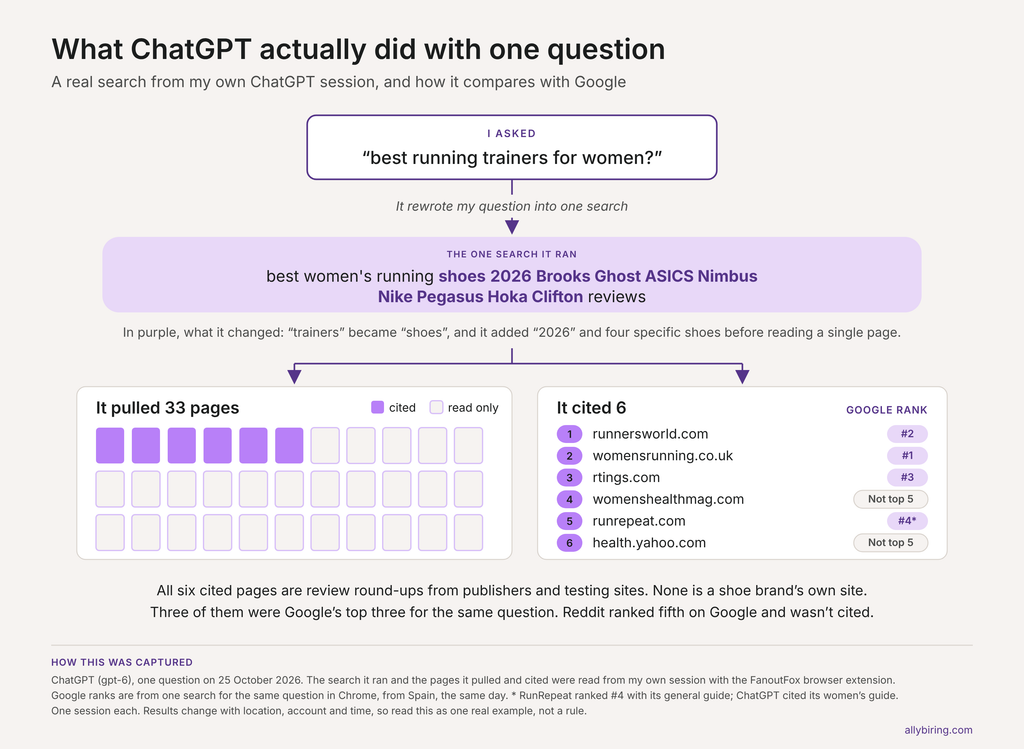
The likely reason: when you ask one question, the assistant quietly rewrites it into one or more searches of its own, then stitches the answer together from what comes back. The industry calls this query fan-out. So the page it cites may rank brilliantly for one of those hidden searches, not for the exact thing you typed. Google says its own AI features do this, and Ahrefs measured ChatGPT running 1.6 extra searches per search on average. OpenAI hasn’t spelled it out, so for ChatGPT it’s a strong inference rather than a documented fact.
Why you should care: good SEO gets you in the room. It doesn’t guarantee a seat. AI search sits on top of SEO, not instead of it, which is the whole point of New acronym, same job.
It does depend on the question, though. When I tested one myself (the diagram below), ChatGPT cited three of Google’s top three. On big “best X” questions, the same few review sites tend to win both. The overlap drops on longer, more specific questions, which is what Ahrefs tested.
What kind of content does each one cite?
This is the part of the whole topic that is the weakest in terms of research, so read it as direction, not rules. You should also notice that two of the big ones have gone opposite ways this year.
| ChatGPT | Gemini | Perplexity | Claude | |
|---|---|---|---|---|
| Leans towards | Official and primary sources, rising fast through 2026. Fresh content too: “2026” was the most common word in its hidden searches | Reddit (about 28% of top-site mentions), YouTube (15%), Wikipedia (9%) | Reddit, YouTube and LinkedIn, on 2025 data | No decent public study |
| Collapsed: from roughly 1 in 5 answers in March 2026 to 1 in 43 by late September, per Ahrefs’ Brand Radar data | Still its single most-cited site | Historically its top site | Unknown | |
| Sources per answer | Not stated in the same study | Roughly 6 to 8, depending on who measured | Not stated | Unknown |
So anything you read saying “ChatGPT loves Reddit” is out of date, and anything saying “AI assistants love Reddit” is only true of some of them. The ChatGPT shift towards primary sources is the same move I described in Programmatic SEO is back: the originator gets favoured over the aggregator.
What you can actually do
Six things, in order of how much they matter.
- Keep your important content in the page itself. Not loaded by scripts, not tucked inside an app. If a crawler can’t see it, it can’t cite it.
- Keep your brand details and reviews current, everywhere. An assistant answering from memory repeats what it absorbed months ago. This is routine upkeep, not a one-off.
- Be the original source. Your own data, tests and experience get cited. A rewrite of someone else’s page doesn’t.
- Check Bing, not just Google. ChatGPT’s search most likely runs on it. If your site isn’t indexed there, fix that first.
- Don’t block the search crawlers. You can opt out of AI training and still appear in answers. The details are in the technical section at the end, so pass it to whoever looks after your site.
- Work with your SEO: If their doing great work with you already they will be the right people to steer you through this new era of search. If you need to find a new SEO team or consultants then look for one’s who are know their SEO.
Four different machines, and the same old work: get found, and be the real source. Proprietary data and human judgement are what clear the bar, not another template.
If you are looking for support with your search strategy, then get in touch.
The technical bit: crawlers, robots.txt and llms.t
This section is for whoever looks after your site. The question it answers: can you block AI from training on your content without disappearing from answers? Yes, for three of the four. Each company runs separate bots for training and for search, and you can treat them differently. Google is the exception, and it’s worth understanding why.
| ChatGPT | Gemini | Perplexity | Claude | |
|---|---|---|---|---|
| Block to opt out of training | GPTBot | Google-Extended, a robots.txt rule rather than a separate bot. Blocking it also removes you from Gemini’s search-grounded answers, but doesn’t touch your Google rankings | None. Perplexity says it doesn’t use its crawler for training | ClaudeBot |
| Allow to appear in answers | OAI-SearchBot | Googlebot. Block that and you leave Google Search as well | PerplexityBot | Claude-SearchBot |
| Fetches a page because a user asked | ChatGPT-User | Google-Agent, which Google says generally ignores robots.txt | Perplexity-User, which Perplexity says generally ignores robots.txt | Claude-User |
The Gemini row works differently from the rest, so it’s worth spelling out. With Google you can’t separate training from search-grounding: Google-Extended switches off both at once. What you can do is block it without losing your Google rankings, which is a cleaner trade than it sounds.
That search crawler is doing more of the work lately, at least for ChatGPT. Carl Hendy, co-founder of Salience, looked at about 1.5 billion server requests and found that since mid-August 2026, ChatGPT’s live page fetches fell by roughly 80% while its search crawler’s visits more than doubled. His read is that it’s “consistent with a shift towards crawling and indexing content in advance, rather than fetching pages during individual conversations.” That’s his interpretation, not something OpenAI has said, but it makes letting OAI-SearchBot in matter more, not less. Foroutan’s logs in November showed the same pattern: ChatGPT-User fetching less, OAI-SearchBot taking over since mid-October.
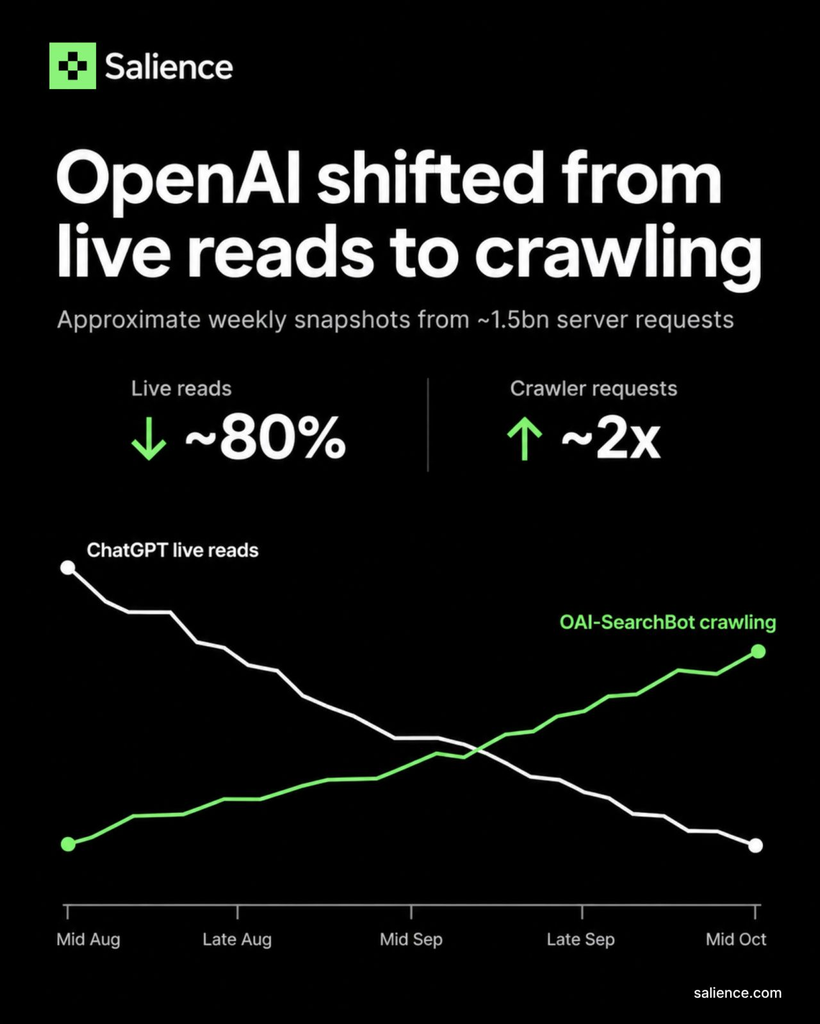
Image source: Salience, a server log intelligence platform, and Carl Hendy on LinkedIn
One more caveat. In a test by Vercel, the main AI crawlers didn’t run JavaScript, so content that only appears after scripts load may be invisible to them. The vendors don’t document this either way, so keep your important content in the page itself.
Update, 13 November 2026. This may be shifting, at least for ChatGPT. Mohammad Foroutan, who checks ChatGPT’s fetching against his server logs every week, reported that the copies of pages ChatGPT holds in its own search index, the ones OAI-SearchBot crawls, now appear to be rendered with JavaScript, at least partly. The live fetcher, ChatGPT-User, still reads the bare HTML.
On one JavaScript-heavy product page, the live fetch saw a search box and nothing else, while the cached copy had the full product grid, filters and prices. One site, one person’s logs, and nothing from OpenAI, so treat it as an early sign rather than a rule. Two catches he flags: the cached copy can be days or weeks old, and you don’t control which version ends up in the answer. The advice above holds. Keep what matters in the HTML, and let OAI-SearchBot in.
While we’re on files that live at the root of your site, a quick note on llms.txt, since people keep asking whether they need one.
| robots.txt | llms.txt | |
|---|---|---|
| What it does | Tells crawlers which parts of your site they can and can’t visit | Gives AI tools a tidy Markdown summary and map of your key pages |
| Who reads it | Search engines and AI crawlers that choose to respect it | Any AI tool that chooses to look for it |
| Is it a standard? | Yes, formalised as RFC 9309 in 2022, after decades as an informal convention | No. A proposal from September 2024 |
| Do you need it? | Yes, and check it isn’t blocking AI crawlers | Optional. Google says no new AI text files are needed for AI Overviews or AI Mode |
If you want to add an llms.txt, it won’t hurt. Just don’t expect it to do anything yet.
Sources
- OpenAI:
- how models are trained, ChatGPT search and its help page, crawlers. User figures via TechCrunch, Feb 2026 and Bloomberg, Jul 2026.
- Google:
- Perplexity:
- Anthropic:
- web search, knowledge cutoffs, crawlers, supplier list. Subscriptions via TechCrunch, Mar 2026; Brave via TechCrunch, Mar 2025.
- Studies:
- Ahrefs on ChatGPT query fan-out and citations, published Oct 2026; Ahrefs on AI search overlap with Google, Jul 2025 data, published Aug 2025; Ahrefs on Gemini’s most-cited domains, Sep 2026; Graphite on forced search, Aug 2026; Lily Ray in Search Engine Journal, Feb 2026; Carl Hendy, Salience, Oct 2026; Mohammad Foroutan, LinkedIn, Nov 2026, on OAI-SearchBot and JavaScript; Vercel on AI crawlers and JavaScript, Dec 2024; BrightEdge, Jan 2026 and Profound, Sep 2026 on Gemini citations; Semrush on most-cited domains, Nov 2025; Microsoft on its grounding infrastructure, Jun 2026; Search Engine Land on the OpenAI scraping report, Aug 2025; Similarweb’s September 2026 traffic shares, posted on X in October 2026 (its gen-AI stats page carries the May figures).