
Back in the day, the day being 2023, I went to one of those fancy summit events put on by one of our incumbent vendors. You know the ones. A nice venue in London, some finger food and drinks, and a series of talks on a hot topic. For this vendor, the topic was the future of search in an AI world.
The talks, given to a room full of their own clients, centred on how search would evolve to the point where websites no longer existed and nobody would know how to get their content surfaced in this new age. AI would, their words not mine, “revolutionise the digital landscape”.
Then we got to the point of the entire event. Your online presence is about to disappear, brand matters more than ever, local search especially. I won’t argue with any of that. I started arguing when, in the next breath, the solution turned out to be their location pages. The strategy: a location-plus-keyword page for every product and every keyword you want to target.
If you have been around as long as I have, those are doorway pages.
By the end, my colleague, not an SEO, was telling me technical SEO and content optimisation were finished.
Like so many times in my career, here we are again. The headline: SEO is dead, the shiny new thing is the thing, and…
I sat there thinking the thing I always think. Why does everyone have to make digital so fucking complicated.
The short version
If you’ve been told SEO is dead and something with a new acronym has replaced it, here it is:
- The acronyms are new. The work isn’t. GEO and AEO sit on top of SEO, and Google says there are no extra requirements to appear in AI Overviews or AI Mode.
- Do the fundamentals. Let the crawlers in, write for a person, structure it so a machine can follow, grow your brand, know your buyer’s journey.
- The panic is the product. “Do the basics well” doesn’t come with a retainer, so the same fundamentals get renamed and sold back to you.
The rest of this post is the thinking behind it all.
AEO, GEO, ei ei oh… SEO
Nobody selling you a new acronym will say the quiet part out loud, so I will. There is no new secret. GEO, AEO, whatever gets coined next quarter, it all folds back into the same job I have been doing for fifteen years. The label changed. The work did not.
AEO, answer engine optimisation, means getting your content picked as the answer, whether that’s a featured snippet or a voice assistant reply. GEO, generative engine optimisation, is newer.
Researchers coined it in 2023 for getting your content used and cited in AI-generated answers, like AI Overviews, ChatGPT and Perplexity. And SEO is just plain old search engine optimisation.
AEO and GEO are a layer on top of SEO, not a replacement for it. Don’t take my word for it. Google’s own documentation says “There are no additional requirements to appear in AI Overviews or AI Mode.”
If you want to show up, in Google, in Bing, or in an answer ChatGPT spits out, get your house in order first.
What does that mean? Erm. Do some SEO. Make some content. Get social. Promote your brand.
Doing some SEO
Not much has changed. What has changed is where the click goes and how you measure it. The work that earns you the visibility hasn’t.
Just like Googlebot, AI bots need to crawl your site. So dig out the technical recommendations your SEO gave you months ago and get them fixed. Check your robots.txt is not blocking the AI crawlers. None of this is scary. It is the stuff your SEO or agency should already be doing.
You will also hear about llms.txt, a proposed file that gives AI tools a tidy summary of your site. It is a suggestion from 2024, not a standard, and Google’s own documentation says you don’t need any new AI text files to appear in AI Overviews or AI Mode. Add one if you like. It takes ten minutes. Just don’t let anyone sell it to you as the thing that gets you into ChatGPT.
| robots.txt | llms.txt | |
|---|---|---|
| What it does | Tells crawlers which parts of your site they can and can’t visit | Gives AI tools a tidy Markdown summary and map of your key pages |
| Who reads it | Search engines and AI crawlers that choose to respect it | Any AI tool that chooses to look for it |
| Is it a standard? | Yes, formalised as RFC 9309 in 2022, after decades as an informal convention | No. A proposal from September 2024 |
| Do you need it? | Yes, and check it isn’t blocking AI crawlers | Optional. Google says no new AI text files are needed for AI Overviews or AI Mode |
Then check you are indexed in Bing. ChatGPT’s web search most likely runs on Bing. OpenAI has never named its providers, but Microsoft says its own search infrastructure powers ChatGPT, and it was later reported to be pulling Google results through a scraping service too (Search Engine Land). I go through where each assistant gets its results in How ChatGPT, Gemini, Perplexity and Claude actually find your content. So when someone tells you they have cracked “ranking in ChatGPT”, ask them whether the site is even indexed in Bing. If it isn’t, you’re starting a step behind.
One thing worth knowing: most AI crawlers do not run JavaScript. They read the raw HTML and move on. In 2024 Vercel and MERJ went through more than 500 million GPTBot fetches and found zero JavaScript execution. The exception is Google, whose Gemini uses Googlebot’s rendering.
Update, 13 November 2026. There’s an early sign this is changing for ChatGPT. One practitioner’s server logs suggest the pages ChatGPT keeps in its own search index are now being rendered with JavaScript, while its live fetcher still isn’t. I’ve put the detail, and the caveats, in the explainer post. The rule here doesn’t change: if it matters, it goes in the HTML.
So your page can sit at number one on Google and be a blank shell to ChatGPT, Claude and Perplexity at the same time. If your content only appears after the page renders, they cannot see it. Server-side, or not at all.
Get it done. If AI crawlers cannot crawl your site and, let’s be honest, lift your content to use on their platforms, you do not stand a chance.
Doing some content
Always create content for a person. A real human has a question. Answer it, at the top, in plain language, before you do anything clever. Explain it properly further down, in the detail it deserves. Then mark it up so a machine can read it without guessing.
Clear, concise, audience first. Then your brand tone of voice and messaging. Then optimised for search. That order matters: user, then brand, then SEO. In that order.
Content is not complicated. What stumps most organisations is the word AI. It appears, everyone panics, and off they go reinventing the wheel. You do not need to. You need content that serves the user’s need, holds your brand, is optimised for search, and has the right call to action. That is it.
Keyword research has not died
It has just got more interesting. If you have worked in B2B like I have, mapping keywords to the top, middle and bottom of the funnel will be second nature. It is no different from awareness, consideration and conversion mapping. That has not changed. Paid will be mapping theirs. If SEO isn’t, stop here and sort that first.
For years, this mapping meant SEOs recommending a tonne of landing pages, blogs and guides, all built onsite, and hey presto, job done. Not really. It never was.
What you actually do is look at the marketing funnel, map your channels onto it, take one real case study of your target customer, and map their stages against it. We already have TikTok SEO and YouTube SEO. Plenty of tools sit alongside Ahrefs, SparkToro and the like, to build keyword research that is genuinely aligned to how people search.
There is a name for it now: query fan-out. When someone asks AI Mode a question, Google does not run one search. It fires off a cluster of related sub-queries, answers each, then builds a single reply. Ranking for one keyword no longer cuts it. You have to cover the whole set of questions a real person asks around a topic. Which is, funnily enough, exactly what mapping keywords to a proper user journey was always for. Google’s own 2026 data backs it up: AI Mode queries run about three times longer than old-school searches, and people ask far more follow-ups. So map the questions, not just the keywords.
Brand, brand and more brand
Getting mentioned by name, anywhere credible, now matters more than a link. That was always PR’s job, which is why SEO and PR should be one conversation.
In old-school SEO thinking, brand meant domain authority. That was the thing you wanted to grow, and you grew it by earning links on high-authority, topically relevant sites. Cue the eternal turf war between SEO and PR over who owned that, and who got to say what. I have seen and heard it all. But both sides always wanted the same thing: get me featured here.
Guess what.
A 2025 Ahrefs study on what correlates with brand appearance in AI Overviews found the top three are all about the brand rather than the site.
Brand mentions matter more than backlinks now, and by the numbers, quite a lot more: Brand web mentions (0.664), brand anchors (0.527) and brand search volume (0.392). Backlinks came in at 0.218. And when Ahrefs say web mentions, they mean your brand named anywhere on the web: a Reddit comment, a forum thread, a mention with no link at all.
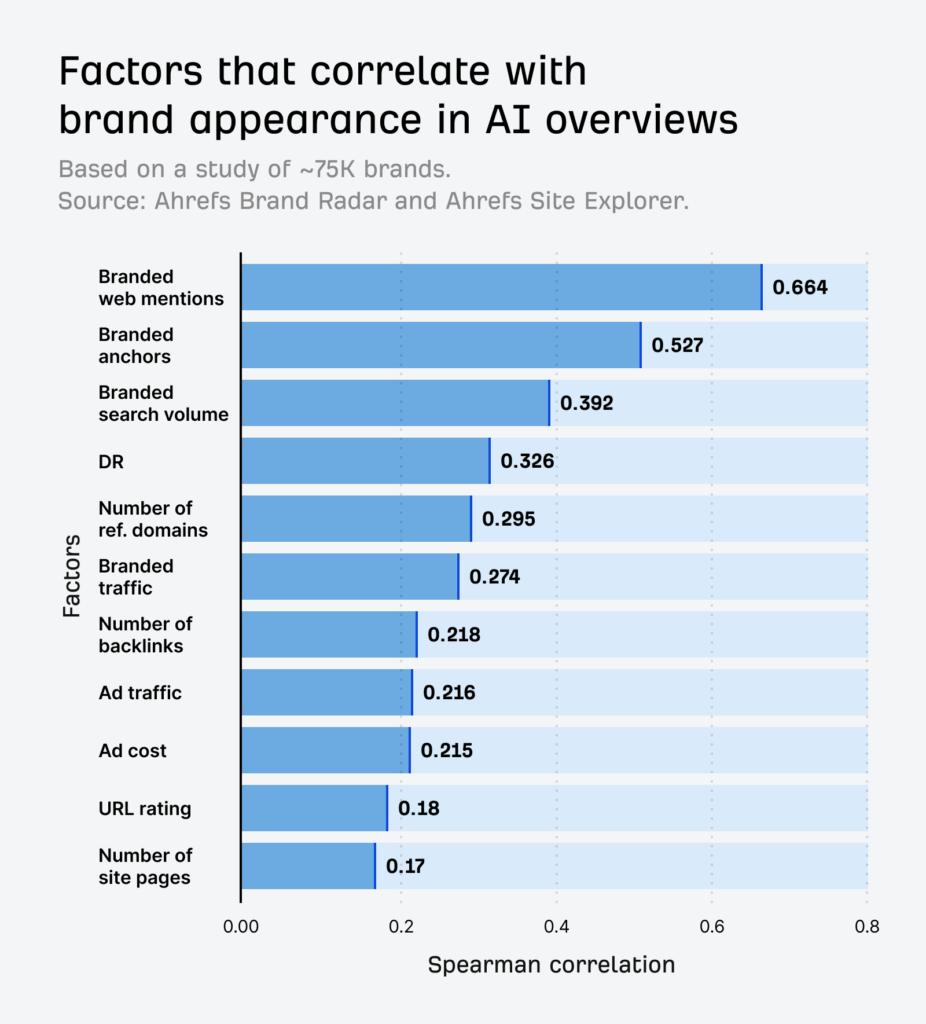
Image source: https://ahrefs.com/blog/ai-overview-brand-correlation/
Correlation is not causation, and Ahrefs say so themselves. Big established brands naturally have both more mentions and more visibility, so brand strength may be doing some of the work. But the direction is clear enough to act on.
Some commentators are now saying SEOs need to widen their skillset and become “a more web-based PR type of role centered around getting your brand mentioned in prominent sources” (Chris Long, LinkedIn). Sound comment. And more eye-rolling from me.
If you are an SEO, or you have one, you should already be fluent in digital PR, which is just link building in a better suit. You should already be earning branded mentions. If they all come with exact-match anchor text, you have a different problem.
That problem has a name. Penguin, Google’s 2012 update that punished keyword-stuffed links, went after exactly this.
Brand mentions have mattered for years. They were just being managed and reported on by a different team, the PR department. Now those same mentions are the thing most closely tied to getting cited in AI answers. Brand reviews, trust metrics, sentiment analysis, all of it has been thrown around in strategy decks and conference talks for over a decade. It is a little embarrassing that we are here, still not joining the dots.
The audience, customer, buyer, whatever you call it, journey
This takes me back to keyword research. I keep seeing pieces that open with “the buyer’s journey is dead”, or some variation. It is not. Dave Chaffey showed back in 2020 that the journey had become wider, not extinct, and Google said much the same with their messy middle.
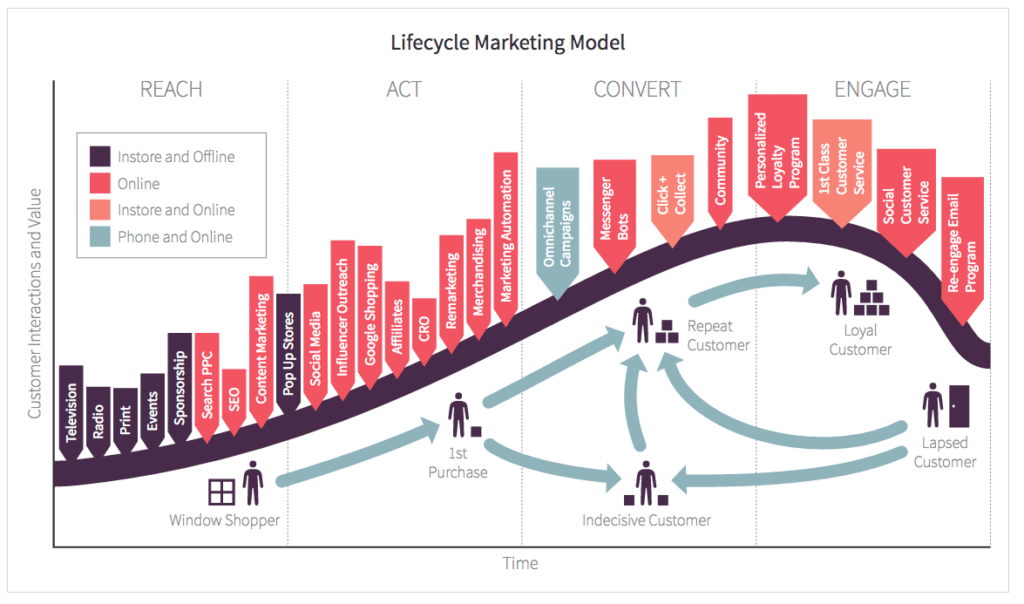
The journey got longer and messier, not shorter. Image source: David Chaffey
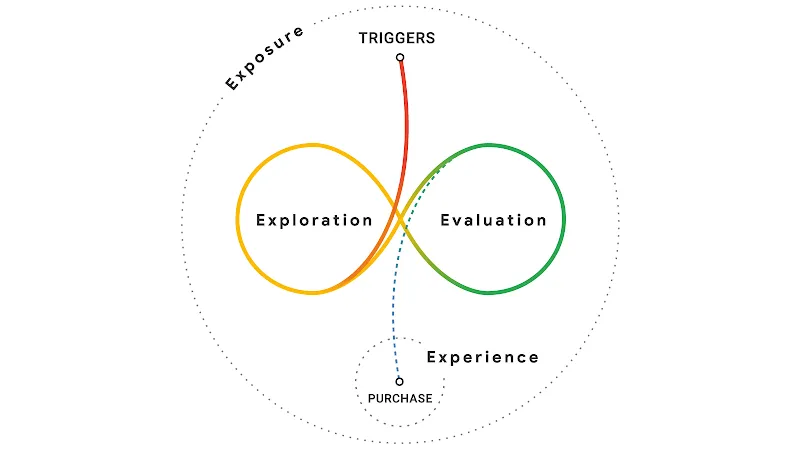
Google’s version of the same point: people loop between exploring and evaluating before they buy. Image source: GoogleThink
Your job is simple. Understand which channels your audience actually use, then work with your SEO, PR, paid and social teams on one joint, always-on marketing strategy. Not campaign by campaign. BAU.
Nail that and you have the holy grail every marketing department claims to want: a genuinely integrated, cross-channel search strategy.
Schema, the “cheat code” to AI success
The part that annoys the people selling schema packages. Schema matters. It is not magic. When researchers tested pages that carried their information only in schema, the AI engines barely picked it up. What won, every time, was clean, visible, well-structured HTML that answered the question on the page (Patrick Ryall, on the SearchVIU study).
One experiment that bolted JSON-LD onto pages moved ChatGPT citations by about two percent, which is to say, nothing (Vistrix Labs). Bing says schema helps its AI understand your content. Google says there’s no special schema you need to add for AI features. Neither says it gets you cited.
So mark your pages up, and do it properly. Experiment with the types that fit your content. Just do it because it is basic hygiene that helps a machine understand you, not because someone sold it to you as the cheat code. It is not the cheat code. It is the fundamentals, sitting where the machine can see them.
The key takeaways
There are none.
Which brings me back to that room in London. If the honest answer is “there is no trick, just do the fundamentals properly”, you can see the problem. Nobody can sell that. “Do the basics well” does not come with a retainer. So the same fundamentals get repackaged, renamed and sold back to you with a fresh acronym and a note of panic. The panic is the product.
Same job it always was. Just done properly, across a whole marketing team rather than in a silo. Which was always the hard part.
If that is the kind of thinking you want on your side, work with me.
Sources
- Doorway pages:
- https://developers.google.com/search/docs/essentials/spam-policies#doorways
- Bing schema confirmation:
- SerpApi story:
- Google AI Mode US insights, 2026:
- https://blog.google/products-and-platforms/products/search/ai-mode-us-insights/
- Origin of the term GEO:
- https://arxiv.org/abs/2311.09735
- AI crawlers don’t render JavaScript:
- Query fan-out and Google AI Mode:
- Ahrefs brand visibility study (0.664 etc.):
- https://ahrefs.com/blog/ai-overview-brand-correlation/
- Chris Long on SEOs and web PR:
- https://www.linkedin.com/posts/chris-long-marketing_seo-data-study-an-analysis-from-ahrefs-found-activity-7334185782213033986-NI0k/
- Google Penguin:
- https://moz.com/learn/seo/google-penguin
- ChatGPT web search and Bing:
- https://searchengineland.com/chatgpt-search-microsoft-bing-seo-448019 and https://yoast.com/chatgpt-search/
- https://commandline.microsoft.com/grounding-system-agentic-web-engineering-retrieval/
- Schema-only pages barely extracted, visible HTML wins:
- https://patrickryall.com/articles/structured-data-ai-crawlers
- JSON-LD experiment, ~2% change in ChatGPT citations:
- https://vistrixlabs.agency/schema-structured-data-geo-facts/