
Everyone is talking about programmatic SEO again. My feeds are full of it, the tools are multiplying, and the “10,000 pages in a weekend” crowd is back with a fresh coat of AI paint.
If the term is new to you, programmatic SEO means building pages from a template and a data source, one page per row of data, instead of writing each one by hand.
I’m not here to knock it. I’ve built it. Programmatic was one of my key strategic bets for an iGaming sports betting brand I managed, and done properly, the benefits far outweigh the negatives.
The trouble is that hardly anyone pays attention to the negatives. Without guardrails, and a regular cadence of iterating on your templates and building unique flows into them, programmatic has the potential to sink your entire site.
The guardrails make or break the whole thing. (How much programmatic should a single page actually contain? That deserves its own post, and it’s coming.)
Programmatic SEO did not disappear. AI didn’t upgrade it. It’s just raised the bar.
One thing people did get right, the thin version died
For most of the early 2020s, programmatic SEO was a cheap bet. Spin up a template, swap the team names, publish “Arsenal v Chelsea: odds, prediction and preview” for every fixture in the league, and skim the long tail.
Like all things in SEO, it worked until it didn’t. And like anything with genuine upside, plenty of SEOs looked at it as a shortcut and abused the fuck out of it.
SEO analyst Lily Ray has documented the pattern across hundreds of sites: a program can look healthy for months, then lose most of its traffic in a single update with no warning.
This is not history. It’s still happening in 2026. Google shipped core updates in March and May, then a spam update in August, and each one tightened the screws on scaled content. Trackers reported scaled and programmatic sites losing anywhere from a fifth to most of their traffic (Google’s policies on scaled content). And the detection got smarter. It stopped hunting for duplicate words and started reading structure, so bolting AI-written intros onto identical page skeletons is now a way to get caught, not a way to hide.
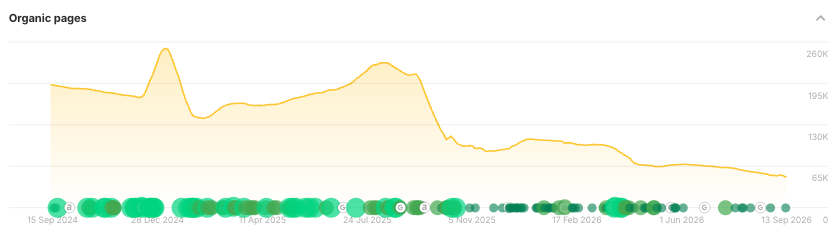
G2’s organic visibility, via Ahrefs. A long bleed that falls off a cliff in 2025 and never recovers.
Now stack the search behaviour changes on top and you can see why the thin model stopped paying. In the first four months of 2026, 68 percent of US Google searches ended without a click, up from 60 percent in 2024. AI Overviews now show on more than a fifth of searches, and when one appears it cuts clicks to the top result by nearly 60 percent. Definition-style pages, the exact thing thin programmatic loves to churn out, got hit hardest.
No one should be surprised by this. Doorway pages, thin-content guidelines, we have had these rules for years. A slightly sexier, fancier way of doing things does not mean they stop applying.
Now the part the panic headlines miss, the good version never left
While the thin sites burned, the disciplined ones kept thriving. In 2026, Wise still pulls tens of millions of organic visits through its currency converters. Zapier has thousands of integration pages. Canva’s template gallery drives millions of visits. Home Depot reportedly has over 2 million-plus programmatic pages and they are fine.
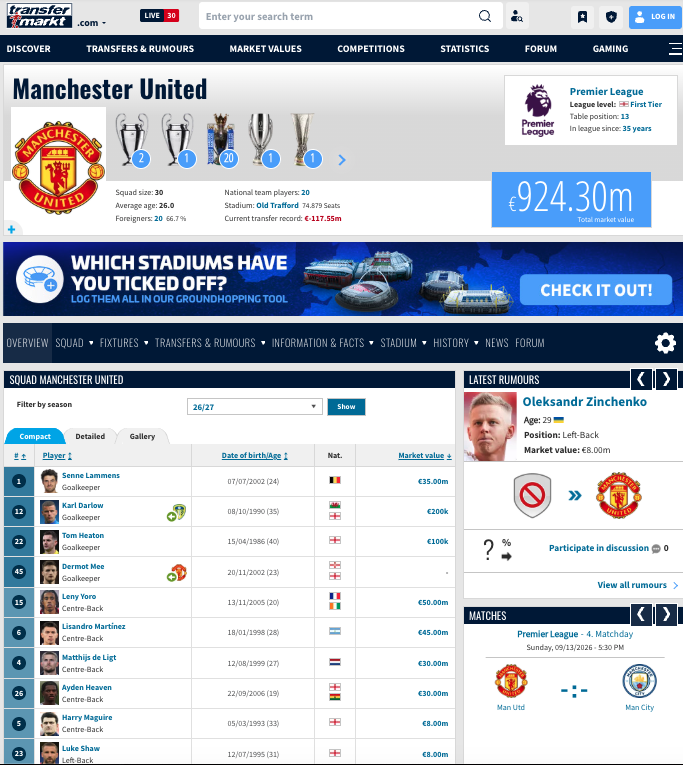
Image: Manchester United on Transfermarkt. Every club gets a page off the same template, and every one is packed with real squad and market-value data. Programmatic done right.

Image: Wise’s currency converter. One page per currency pair, a live rate on each, and tens of millions of visits a month. Every page actually answers the question.
The difference is not effort or polish. It is that every one of those pages carries something real. A live exchange rate. A specific integration that actually exists. A template you can use. The page is not a keyword wearing a costume. It is a genuine unit of data, published at scale. It answers a real intent.
There is a sharper version of this worth clocking. Lily Ray’s analysis at Amsive found the 2026 updates pushing Google toward originator domains, the actual employer, hotel or product provider, and away from the aggregators that repackage everyone else’s data. In travel, jobs and finance, first-party sources gained ground. So republishing other people’s information at scale is finished. Being the source is the game now.
This was the very line that the 2026 updates drew. Google did not ban automation. Thin pages with no real value pumped out at scale is what got killed off.
Why it got fashionable again, AI pulled two levers at once
So why now? AI did not revive programmatic SEO by being kind to it. It revived it by changing the economics on both ends.
On the supply side, building programmatic content got absurdly cheap. Wiring an LLM to a data source and a publishing layer is now a fraction of the cost per-page of the old craftsman model, and dramatically faster.
Get yourself an n8n subscription (an AI automation workflow platform), a bit of Claude, some in-house data feeds and a few external APIs, bolt on a WordPress blog, and Bob’s your uncle, you have got the building blocks of an in-house programmatic setup.
This is how spammers flooded back, and exactly why Google had to swing the axe. The cost of making a thousand mediocre pages fell to almost nothing, so mediocre pages stopped being worth anything.
On the demand side, and this is the real shift, AI answers became the main event. Google’s AI Overviews now reach more than 2.5 billion monthly users, and AI Mode passed a billion in its first year. That surface runs on precisely what good programmatic produces.
An AI Overview or a ChatGPT answer does not browse a page like a human. It wants clean, structured facts, named things and hard numbers, broken into tidy chunks it can lift and cite. A well-built programmatic page, one row of real data expressed as a clear, consistent page, is close to the ideal shape for that. You are not writing an essay for a reader to enjoy. You are laying out a fact for a machine to quote.
Which tells you what happens when there is nothing to lay out. Growth advisor Gaetano DiNardi flagged this as one of the drivers of G2’s collapse, remember that graph earlier: down around 80 percent since 2023, and because its thin programmatic pages hold so little real content, AI has almost nothing to extract, so G2 barely shows up in AI answers, which only speeds the erosion. Nothing to quote, nothing to cite.
And the traffic that survives is better traffic. Semrush found visitors arriving from AI search convert at around 4.4 times the rate of standard organic. Fewer clicks, much higher intent, because the people who click through an AI answer have already been pre-sold by the summary. The catch is that AI search hands almost all of that reward to a small club. Brands cited in an AI Overview earn roughly 120 percent more clicks per impression than the ones it leaves out. Authority is the permission slip. Without it, your perfectly structured pages just do not get picked.
Not “the tactic is back.” More like this: AI made the cheap version worthless and the disciplined version more valuable at the same time. Everything in the middle got squeezed out.
The trap most SEOs and businesses will fall into
Build it, switch it on, and it’s all gravy, baby. It really isn’t.
The current pitch is that the route into AI citations is schema. Add structured data, mark everything up, and the machines will cite you. You will see 2.5x and 3.2x uplift numbers thrown around confidently.
The most rigorous test we have says no. Ahrefs tracked 1,885 pages that added JSON-LD schema (learn more about JSON Mark up ) against 4,000 matched controls and found no meaningful lift in AI citations on any platform. On Google’s AI Overviews there was even a small decline. Their explanation is the part worth tattooing somewhere: pages that add schema tend to be pages that already do everything else well.
They have the authority, the links, the maintained content. Strip the markup and the rest still carries them. The schema was a symptom of quality, not the cause of the citation.
The markup, the template, the automation, none of it is the edge. The edge is the substance underneath it. The proprietary data. The correct fact. The judgment about what is worth publishing at all.
And this is the part that actually matters, because programmatic SEO is really a data product dressed up as search pages. The trouble is everyone is about to build the same one.
Remember that cheap stack from earlier, the n8n, the bit of Claude, the data feed, the WordPress blog? Everyone else has it too. When the whole industry runs near-identical workflows, they spit out near-identical pages. Same skeleton, same sections, a thin layer of unique data poured on top. We have seen this film before. It is the same lesson the 2026 crackdown taught, all over again.
And Google is already reading for it. Google’s scaled content abuse policy says it doesn’t matter whether pages are made by automation, humans or both. Running your data through an LLM to reword the intro does not fool it. A handful of unique fields on a stock template is not a moat. It is a slightly better disguise.
So the next level is not more pages. It is more bespoke pages. And that starts with a question almost nobody asks before they start scaling: does every keyword actually want the same template?
It does not. Someone searching “Arsenal v Chelsea odds” wants live prices, form and a fast verdict. Someone searching “how to bet on corners” wants a proper explainer. Someone on “best sites for accumulators” wants a comparison they can trust. Three intents, three completely different pages. Pour all three into one master template and you have built a doorway with extra steps. Map one template to one intent and one job, keep informational and transactional apart, and you are building something Google still has a reason to reward.
That is the work AI cannot do for you. The machine can now generate a thousand pages before lunch. That was never the hard part. The hard part is having a thousand things actually worth saying, knowing which intent each one really serves, and building unique flows. Knowing the difference.
And let’s be honest about what the other ten thousand are really doing. Cheap, fast, scale, churn. That was the programmatic pitch in 2019 and it is the pitch now. AI didn’t reinvent the model. It made the filler cheaper to produce and a bit better at hiding.
A bad workman blames his tools. AI hasn’t changed that. It has just handed bad workmen a faster one. The data, the intent, the judgment about what is worth publishing at all, that is the human on top. The rest is just filler with better grammar.
If you want a content system that scales without turning into filler, work with me.
Sources
- What programmatic SEO is: https://www.semrush.com/blog/programmatic-seo/
- Lily Ray on programmatic traffic collapses: https://heroicrankings.com/seo/content-creation/programmatic-seo/
- Google’s 2026 core and spam updates (Search Status Dashboard): https://status.search.google.com/products/rGHU1u87FJnkP6W2GwMi/history
- Google’s scaled content abuse policy: https://developers.google.com/search/docs/essentials/spam-policies#scaled-content
- Doorway pages: https://developers.google.com/search/docs/essentials/spam-policies#doorways
- 68% zero-click searches, 2026 (SparkToro): https://sparktoro.com/blog/in-2026-less-than-one-third-of-google-searches-still-send-a-click/
- AI Overviews and click-through to the top result: https://searchengineland.com/google-zero-click-searches-2026-study-479717
- G2’s traffic loss (Gaetano DiNardi): https://www.linkedin.com/posts/officialg_g2-has-lost-an-astonishing-80-of-their-seo-activity-7272999357669412867-7NeV/ and https://airops.com/blog/hidden-dangers-of-programmatic-seo
- Wise SEO case study: https://ahrefs.com/blog/wise-seo-case-study/
- Zapier, Canva and Home Depot page counts: https://www.get-ryze.ai/blog/programmatic-seo-vs-traditional-seo-when-use-ai-agents
- Manchester United on Transfermarkt: https://www.transfermarkt.com/manchester-united/startseite/verein/985
- Wise currency converter: https://wise.com/gb/currency-converter/gbp-to-eur-rate
- Amsive March 2026 core update analysis (Lily Ray): https://www.amsive.com/insights/seo/google-march-2026-core-update-winners-losers-analysis/
- n8n: https://n8n.io
- AI Overviews 2.5 billion users, AI Mode 1 billion: https://keywordseverywhere.com/news/ai-overviews/
- AI search visitors worth 4.4x organic (Semrush, 2025): https://www.semrush.com/blog/ai-search-seo-traffic-study/
- Cited brands earn ~120% more clicks per impression (Seer Interactive): https://www.seerinteractive.com/insights/aio-impact-on-google-ctr-2026-update
- Top 1% of domains capture 64% of citations: https://organikpi.com/blog/geo-ai-search/state-of-ai-search/
- Schema uplift claims: https://www.stackmatix.com/blog/structured-data-ai-search
- Adding schema didn’t lift AI citations (Ahrefs): https://ahrefs.com/blog/schema-ai-citations/
- Small decline on AI Overviews: https://www.seroundtable.com/study-schema-citations-study-41311.html
- What JSON-LD and structured data are (Google): https://developers.google.com/search/docs/appearance/structured-data/intro-structured-data
- One template per intent: https://www.primecodia.com/pages/blogs/blog-programmatic-seo-2026.html
- Related post, New acronym, same job: https://allybiring.com/new-acronym-same-job/