
I’ve been working in search for fifteen years, as some of you will have noticed from the signposts on this site and on my LinkedIn 😉. Even I am struggling with what’s being said about AI search at present.
Not because I don’t understand it (where I don’t understand something, I’ll flag it!), but because the space is already stuffed with people talking far too confidently, throwing buzzwords around and waving questionable test stats about as proof.
Some of it is because they want to be seen to know.
And that’s the problem. If you’re a business owner or marketing lead trying to make sense of all this, how are you supposed to separate what’s genuinely useful from what’s just noise?
This is the second post in a small series I’m writing to make sense of it all, get to the bones of what’s actually happening, and leave the nonsense and posturing behind.
The first covered how the assistants actually find your content.
This time, we’re looking at something that sounds straightforward but really isn’t: citations, links and recommendations.
Because they’re three different things. And confusing them could mean spending money on the wrong thing.
The bones of it: the key things to know
- When someone says their business was “cited by AI”, they might mean three different things:
- A citation is the page it presents as a source.
- A recommendation is the name it picks
- A link is the destination it gives you to click.
- Most tools track citations and links. But the thing that matters commercially is whether the assistant recommends your business, and that’s also the hardest thing to measure. When Ahrefs tracked 37,500 citations for 20 days, most cited sites weren’t even named in the answer: 84% on Google’s AI Mode, 54% on ChatGPT.
- A link doesn’t necessarily mean much traffic. People read the answer and move on. Pew found that people clicked a link inside a Google AI summary on 1% of visits, and Marie Haynes’ analysis of 145 million sessions put ChatGPT at 0.62% of Google’s organic traffic. The visitors who do arrive may be valuable. There just aren’t many, and some are hard to spot in your analytics because the referrer is often missing.
- The assistant often reads your detailed guide and links your homepage. Same brand, different page. In nine million answers, ChatGPT’s link was the page it cited less than a quarter of the time and seven in ten links went to a homepage. Dashboards blur the two into one score.
- Low clicks do not mean low influence. The recommendation happened whether or not anyone clicked. It comes back later as someone searching your name: Similarweb found people were two and a half times more likely to visit a brand’s site in the week after ChatGPT recommended it, mostly via search, and Scrunch saw new customers nearly three times as likely to Google the brand.
- If you’re paying someone for this, make them tell you which of the three they’re improving. Ahrefs tested it on themselves (AI Search Benchmark Report, Q2 to Q3 2026): when an assistant cited their own “best of” page, it recommended a competitor from the same page 43% of the time. Cited isn’t picked.
If this has caught your attention, let’s jump straight in!
What is a citation, a link and a recommendation?
One of the reasons AI search is so confusing is that people are using the same words to describe quite different things.
Tool vendors talk about the metrics their products measure. Practitioners use shorthand they’ve picked up from each other. And somewhere in the middle, business owners and marketing teams are trying to work out what any of it actually means for them.
The problem is that citations, links and recommendations are often lumped together as though they’re interchangeable.
They’re not.
And if you’re measuring the wrong one, you could end up with a very impressive-looking AI visibility report that tells you surprisingly little about whether AI assistants are actually recommending your business.
So before we get into the detail, let’s establish what these three things actually mean.
These three words have been doing jobs in marketing for decades. None of them changed meaning when AI search arrived. What changed is where they happen and who’s counting.
| What it has always meant | What this is in traditional search | What this is in AI search | |
|---|---|---|---|
| Citation | An act of quoting; an excerpt or quotation; a mention, such as a formal statement of someone’s achievements. Merriam-Webster | PR: your brand named in a piece of coverage. Local SEO: your name, address and phone listed on a directory, which the trade has called a “citation” for fifteen years. Content: the sources in the article, editorial and so on. |
The page the assistant presents as a source for information in its answer. Usually shown as a numbered footnote or in a Sources panel. |
| Link | A clickable address that takes you from one page to another. | SEO: a backlink, a vote from one site to another. PR: coverage with a link in it. Ads: the destination URL. |
The clickable URL in the answer. Often the homepage, and not always the page it cited. |
| Recommendation | Someone telling you that something is good. A referral. | Word of mouth. Reviews. A journalist’s “best of” list. Google’s results for “best X” are a recommendation with ten blue links on it. | The brand, business or product the assistant actually suggests when you ask what to buy, use or visit. Often with no link at all. |
So when someone says “we got cited by ChatGPT”, or by Perplexity, Gemini etc., they can mean very different things:
- A citation is the page it presents as a source.
- A recommendation is the name it picks
- A link is the destination it gives you to click.
So it really is important to understand the differences, because they don’t tell you the same thing.
You can be cited without being recommended. You can be recommended without anyone clicking a link. And you can have a link to your website without that meaning the assistant actually chose you as its answer.
How do you get each one, and what does the assistant do with it?
| How you earn it | What the assistant does with it | What it tells you | |
|---|---|---|---|
| Citation | Write a page that answers the question properly. Make sure the answer is visible in the HTML, that the page can be crawled, and that it’s discoverable through search engines, including Bing and Google. Good SEO fundamentals still apply, but ranking doesn’t guarantee a citation. | Finds it through its own searches, then attaches it to a sentence as support. Google’s own patent describes one possible approach: write the summary first, then find pages to support its sentences. | Your page was good enough to be used as evidence. It doesn’t mean the answer came from it. |
| Link | You don’t earn an AI link in quite the same way you earn a backlink. The assistant decides where to send the user when it provides a clickable destination. It might be your homepage, a specific page, or even your Google Business Profile. | Provides a clickable destination for someone who wants to take the next step. Tracking parameters may be added to the URL, but don’t assume your analytics will capture every visit correctly. | Someone has somewhere to go if they want to find out more. It doesn’t tell you whether the assistant recommended you, or whether anyone actually clicked. |
| Recommendation | Be the name that comes up. Mentions across the web, reviews, the round-ups your category gets cited from. The things that made it know you before it searched. | Picks from what it already knows, then uses a search to check and fill in. | A potential customer has just heard your name. This is the one that could bring you business, and the one almost nobody measures. |
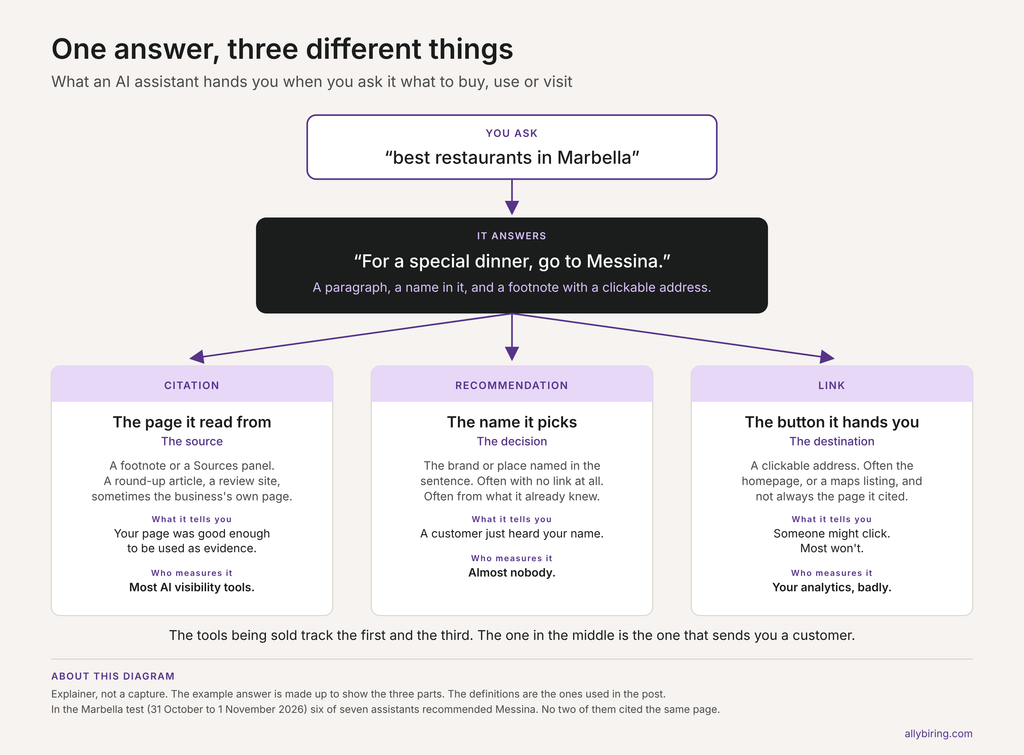
Image: Most tools track citations and links. The recommendation is the one that sends you a customer.
So where does the recommendation come from?
To be honest, I initially thought it came from search. Ask a question, the assistant goes off, looks at a few pages, picks the best option, and sends it back with a fancy bit of copy instead of a list of links or a map.
What can I say? I’m a cynic (realist) at heart.
This is generally speaking, the order most people have in their heads, and it’s the order the tools are built around. It’s not always the order it happens in though.
- AI assistants rarely search at all
Ahrefs looked at 66.6 million ChatGPT answers from August and September 2026 and found 14.4% of them triggered a web search. Call it one in seven. The other six didn’t trigger a live web search. Whatever recommendation they contained wasn’t built from pages fetched through that search. No live search, no citations.
- AI assistants will use search to back up their rationale
In my own capture I asked for the best running trainers for women. ChatGPT ran one search, and the search was: best women’s running shoes 2026 Brooks Ghost ASICS Nimbus Nike Pegasus Hoka Clifton reviews. Four shoes, named, before it had opened a single page. That’s what I observed. What I read into it is that the shortlist was already there and the search went to find pages that backed it. I can’t see inside the model to prove that, but it’s hard to explain four named products in the query any other way.
- AI assistants do “fact check” their answers
I came across a series of posts on LinkedIn where Mark Williams-Cook of Candour broke down one of Google’s patents, Generative summaries for search results, granted in 2023, and what it suggests about how an AI answer gets built and in what order:
- Write the summary first
- Then for each sentence go and search for a page that supports it
- Check that page does support it
- Attach the link
It even lists what makes a page eligible to be attached, any of this ring a bell:
- Ranking
- Location
- Language
- How trustworthy the author and domain look
- Popularity
- Freshness
A patent describes an approach, not necessarily what the live product does on every query.
But it’s Google, in Google’s own words, describing citations as something fetched to fit a sentence after the sentence exists.
What does any of this mean?
The assistant may already have candidates for its answer in mind. It may search, to check and fill in what it knows. It writes the answer. Then it attaches sources. The exact order will vary between systems and between questions, and nobody outside those companies can see it.
There’s one other thing that can affect the answer: personalisation. Depending on what someone has previously asked, liked or disliked, an assistant may leave your brand out altogether.
The point that matters is this: the citation isn’t necessarily where the recommendation came from. Which is why a citation tells you so little about whether you were the source, and why the thing that gets you recommended isn’t only the page.
It’s whether the model already knew your name before anyone asked, and whether that knowledge is enough to make it recommend you. That’s why brand mentions line up with AI visibility far more closely than backlinks do, a point I covered in the acronym post.
What happened when I asked seven of them where to eat
Before getting into the larger studies, I wanted to see what happened when I tried it myself. I asked for
best restaurants in Marbella
The search term is in English, and in Spain the volume is marginally higher than in the UK. I wanted to check that this term, which is grammatically more correct than the parent term “best restaurants Marbella”, had some value in traditional search before I ran the test.
What I’m less sure about is whether people type “best restaurants Marbella” into an AI assistant at all. My guess is they ask it the way they’d ask a friend. That’s a question for another day.
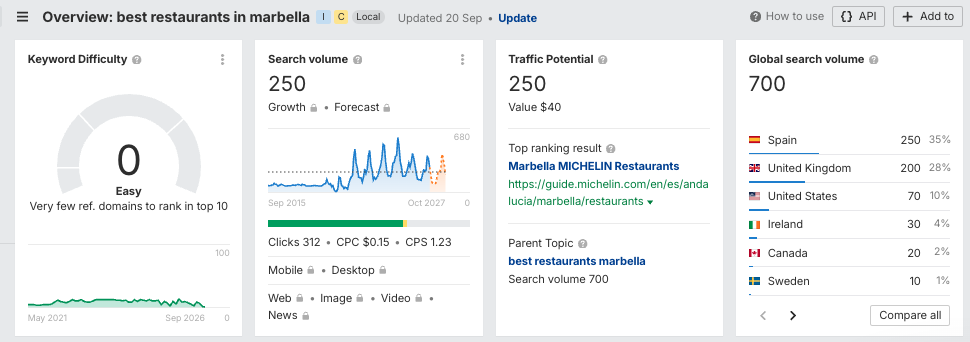
Image: ahrefs global keyword data dashboard, in their keyword explorer tool.
I asked seven AI assistants: ChatGPT, Perplexity, Gemini, Claude, Google’s AI Overview, Google’s AI Mode and Bing’s AI Mode.
Same laptop, two afternoons, 31 October and 1 November, one run each. This is a sample, not a test.
One question, one place, one person. It proves nothing on its own. What it does is show you what the words mean in practice, and the studies that follow show the same pattern at scale.
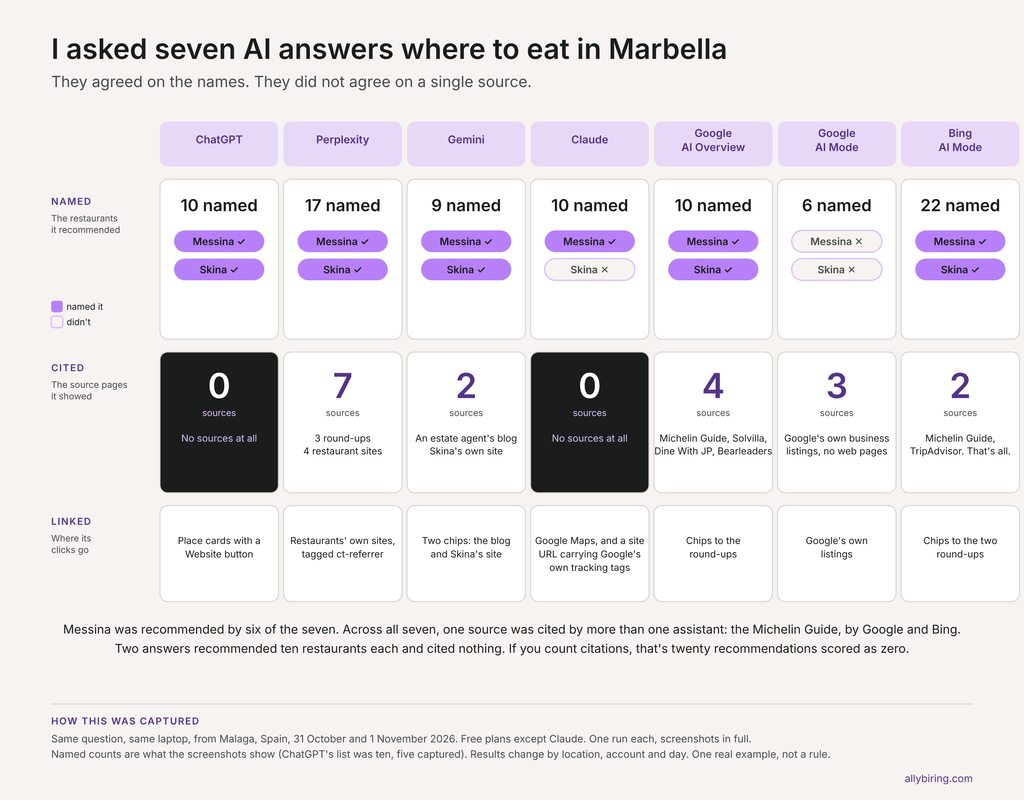
Image: They agreed on the names. They did not agree on a single source.
The names agreed. The sources didn’t.
Messina was recommended by six of the seven. Skina and Leña by five each, BACK by four. Across all seven answers, exactly one source page was cited by more than one assistant: the Michelin Guide, shared by Google’s AI Overview and Bing’s AI Mode.
Every other source was cited once, by one assistant. Perplexity leaned on a hotel group’s travel guide and a luxury magazine. Gemini cited an estate agent’s blog. The AI Overview cited Google’s own top organic results. Seven assistants, largely different sources, and one name coming up again and again. A citation tracker would show you a scatter of unrelated pages. It wouldn’t show you the one thing that was consistent.
Two of them recommended ten restaurants each and cited nothing
ChatGPT gave me ten picks, a map, price bands and Michelin stars, with no Sources button, no footnotes, nothing. Claude did the same: ten picks, no citations, no links in the text. Twenty recommendations, citation count zero. Both still handed me somewhere to click. ChatGPT through a card with a Website button, Claude through a Google Maps box. Recommendation and link, no citation. A citation tracker would score both answers as nothing happened.
That’s not a quirk of my afternoon. In Ahrefs’ 20-day tracking study, 64% of Gemini answers and 53% of Copilot answers contained no citations at all.
One of them cited a restaurant it didn’t recommend
Google’s AI Mode lists La Cabrera in its sources panel. La Cabrera isn’t in the answer. A citation with no recommendation attached to it, on one screen.
The most-cited answer was the most dependent on round-ups
Bing’s AI Mode named 22 restaurants and put a citation on every one. All 22 came from two pages: the Michelin Guide’s Marbella list and TripAdvisor’s. ChatGPT, zero citations, its own ten picks. Bing, 22 citations, two round-ups rewritten with emojis. Citation count is a product design decision. It isn’t a measure of who earned the recommendation.
Every one of them labels the click differently
Perplexity sends you to the restaurant’s own site with its own tag on the URL. ChatGPT normally tags with its own. Claude’s website button sent me to the URL the restaurant had put in its Google Business Profile, Google’s tracking tags and all, so a click from Claude would show up in that restaurant’s analytics as Google organic. Gemini, the AI Overview and Bing sent me to blogs and round-ups, not restaurants. Google’s AI Mode sent me to Google’s own listings. Seven answers, seven formats, and one of them is printed in someone else’s name.
The facts travelled without the footnotes
ChatGPT, Gemini and the AI Overview all gave Skina two Michelin stars, Messina one, BACK one. Only Google’s AI Overview and Bing cited the Michelin Guide for it. The rest presented the same facts without citing the Guide at all. Which is the point of gap four: a recommendation can arrive with its facts intact and no citation anywhere near it.
One honest note: good old-fashioned Google and Bing search listings didn’t agree with each other either.
From Spain, Google gave me the Michelin Guide at number one and a TheFork box instead of a map pack. Bing gave me four ads, a map pack of six places that shared one restaurant with any of the AI answers, and TripAdvisor twice.
The AI answers aren’t the only thing that varies.
The four gaps, and the studies that show they’re not just my afternoon
My Marbella sample showed how much a dashboard can miss. The studies below show that the same gaps appear at scale.
- A citation isn’t necessarily the source.
- A citation isn’t the link.
- A link isn’t traffic.
- And the recommendation, the thing that sends you a customer, is the one the tools measure least.
My afternoon showed all four. The studies below show it wasn’t a fluke.
Gap one: a citation doesn’t mean the answer came from you
A citation isn’t always the page the answer came from. It’s the page the AI assistant attached to the sentence, and those can be different things.
Lily Ray showed that Google’s AI Overviews can put inline citations on sentences the cited page doesn’t contain. Google says this is by design.
The New York Times worked with Oumi to study the same problem at scale. In an analysis of 4,326 AI Overviews, more than half of the accurate answers in the February sample were “ungrounded”, meaning the linked sources didn’t fully support what the answer said.
Google disputed the study, saying it had “serious holes”. Its spokesperson told the New York Post the research used one AI to grade another on an outdated benchmark, didn’t reflect what people actually search for, and that AI Overviews clear the same quality bar as the rest of Search.
Either way, the footnote is the clearest proof for the sentence, not 100% proof of where the words came from. If you want to know what it actually read, you look at the searches it ran, which I covered in How ChatGPT, Gemini, Perplexity and Claude actually find your content.
The studies found two different problems: some citations didn’t support the sentence at all, while others supported only part of it.
What that means for you and your business
A citation count tells you how often your pages were attached to answers. But it doesn’t tell you how often your page content featured in those answers.
Treat it as evidence of being identified as a source, not as proof of being used.
Gap two: a citation doesn’t mean a link to the page that earned it
The second gap is between the page the assistant read and the page it points people at.
It reads your detailed guide, builds its answer from it, then links your homepage. Same brand, different page.
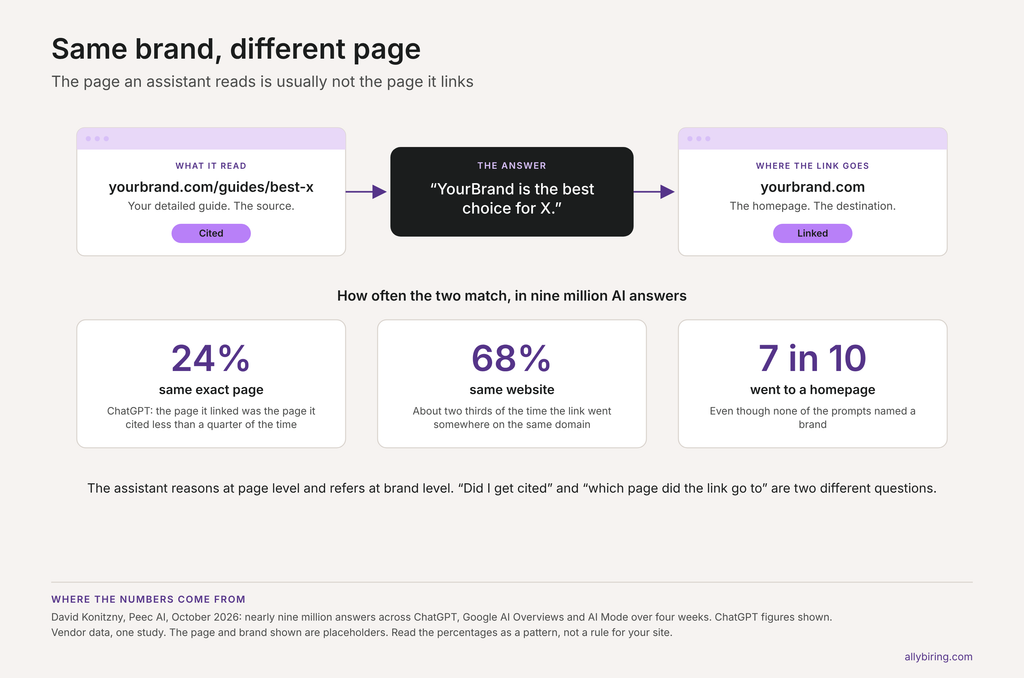
Image: It reasons at page level and refers at brand level.
That’s the normal pattern, and it’s been measured. David Konitzny at Peec AI looked at nearly nine million answers across ChatGPT, Google AI Overviews and AI Mode over four weeks. On ChatGPT, seven in ten outbound links went to a homepage, even though none of the prompts named a brand. The page it linked was the exact page it had cited less than a quarter of the time (24.3%), but the same domain about two thirds of the time (67.5%). The assistant reasons at page level and refers at brand level.
Gap three: a link doesn’t mean traffic
The third gap is the one that can make client meetings awkward.
A link doesn’t necessarily mean meaningful traffic.
The number of clicks you get from an AI link is already small, and that’s before the tracking goes wrong. The people who do click tend to be good visitors, so a small number isn’t a worthless one. There’s just far less of it than the dashboard implies.
The cleanest measurement isn’t from a vendor. Pew Research watched 900 US adults make 68,879 real Google searches in March 2025.
When an AI summary appeared, people clicked a normal result 8% of the time, against 15% when it didn’t. They clicked a link inside the summary itself on 1% of visits. That 1% is specific to links inside Google’s AI summaries, not every AI link everywhere, but it’s the one independent number we have.
And people ended their browsing session more often when a summary was there: on 26% of searches with an AI summary, against 16% without. The answer did the job, so the visit never happened.
Search agency Seer Interactive used its client data to put a number on what a citation is worth. Across 53 brands and 5.47 million queries over 14 months, pages cited inside an AI Overview were clicked 2.07% of the time on informational searches, against 0.94% for pages that weren’t cited.
So cited pages get more than double the clicks of uncited ones, but more than double almost nothing is still almost nothing. Both sit well below the 3.35% a page gets when there’s no AI Overview at all. Seer say themselves they can’t prove the citation causes the difference, since bigger brands are also more likely to be cited.
ChatGPT’s own numbers are harder to get at, but they point the same way.
In late 2025, OpenAI sent publishers a report on how their pages performed in ChatGPT, and one SEO with access shared the highlights.
The report itself was never published, so treat these as relayed second-hand. MarTech’s write-up showed one well-performing page getting 610,775 impressions in ChatGPT answers and 4,238 clicks.
That’s 0.69%. The best page in the report managed 1.68%. Most sat at a fraction of a percent. People read the answer and move on. The link is there if they want to dig further. Most don’t.
Ahrefs reached the same place from the other direction in February 2026, across 76,000 sites: by their estimate ChatGPT handles roughly 12% of Google’s search volume and sends about 190 times less referral traffic. That’s a comparison of traffic volumes, not a measured click rate.
But it reinforces the same point: AI search sends far less traffic than its search volume would suggest.
Then the clicks that do happen are easy to lose.
ChatGPT usually doesn’t pass a referrer, the signal that tells your analytics where a visitor came from. What saves you is a tag: OpenAI adds utm_source=chatgpt.com to the links in its answers, so GA4 can still file the visit under ChatGPT. When the tag is there, you can see it. When it isn’t, the visit lands in Direct, next to the people who typed your URL.
And the tag isn’t always there. In the second week of October 2026, after GPT-6 rolled out, the links inside ChatGPT’s answers lost the tag. Sites watched their ChatGPT traffic fall off a cliff from 9 October while Direct rose by the same amount. OpenAI called it a known bug and the fix rolled out on 15 October. Nothing about the clicks had changed. Only the label had.
Gap four: the recommendation is what matters commercially, and it’s the hardest to measure
If barely anyone clicks, does being in an AI answer even matter?
Yes, and this is the gap that gets skated past, because it’s harder to measure than citations and links, and harder to put on a dashboard.
Start with the cleanest evidence that a citation and a recommendation are different events. In 2026 Ahrefs ran an experiment on themselves: 34 new pages ranking their own products in “best of” lists, tracked across 1.4 million prompts. It got their new conference brand mentioned where it hadn’t been before.
But when an assistant cited one of those pages, it skipped their conference and named a competitor from the same article 43% of the time. Their page was the source. Someone else got the pick. For their established tool the same backfire happened 11% of the time, and their own conclusion was that existing trust decides whether a citation turns into a recommendation.
Then they measured it at scale. Ahrefs tracked 37,500 citations across five AI tools for 20 days and found that most cited websites weren’t named in the answer at all: 84% on Google’s AI Mode, 77% on AI Overviews, 54% on ChatGPT. Cited, not recommended, as the default. And the two things don’t even move together.
Between 50 and 70% of cited sites appeared on one day only, while only about one in five brand names did. On Gemini, 40% of sites lost their citation and kept their mention; 4% went the other way. The URL rotates. The name stays. If you’re tracking citation URLs, you’re tracking the part that churns.
Low clicks do not mean low influence. The recommendation happened whether or not anyone clicked. Someone asked, the assistant said your name, and you’ve entered that person’s thinking. Maybe for a minute. Maybe longer. That’s the event. The click is the receipt, and half the time the receipt never prints.
None of this is new, either. Rand Fishkin’s zero-click research with Datos found that 58.5% of US Google searches ended with no click at all, and that was 2024, before AI Overviews reached most people. Influence without a click has been most of search for years. The assistants didn’t invent it. They removed the last excuse for measuring the wrong thing.
The influence doesn’t vanish, it just stops being traceable. It comes back later as someone searching your brand name. Similarweb measured this in 2026: people who got a ChatGPT recommendation were two and a half times more likely to visit that brand’s site within a week than a close competitor’s, and most of those visits arrived through a search, not a click from the answer.
It’s one panel, US desktop only, and an association rather than proof of cause. But it’s the shape you’d expect if the recommendation is doing the work and the link isn’t.
So citation tracking and link counting tell you what the assistant pointed at, not who it picked. The thing you actually want to know is simpler and harder: did it pick me?
How do I see this for my own brand? Do I need to pay? Phone or laptop?
You don’t need to pay. Free ChatGPT has web search and a Sources panel, which is all you need. Use a laptop, not your phone, so you can see the sources properly and hover over citations.
Turn web search on. Ask the question your customer would ask. Then note three things: did it identify your page as a source, did it say your name, and did it link to you, and to which page. Do it again on a different day. You’re looking for patterns, not a single answer. That’s how I ran the Marbella sample.
If you want to go further, the free FanoutFox extension shows you the searches ChatGPT ran, every page it read and which ones it cited. I used it for the diagram in the first post.
Update, 15 November 2026. OpenAI has since launched a dashboard of its own. Claim your business in ChatGPT’s new Business Hub and it shows you, in OpenAI’s words, “the number of mentions and website clicks” you receive, plus discovery topics, “common themes across conversations where their website is cited”. Worth claiming. Read it with this post in hand, though. OpenAI’s help article says a mention counts when ChatGPT references your website, or shows your listing if you’re a local business, and that “the brand name alone doesn’t count”. That’s what this post calls a citation. The recommendation, the assistant saying your name with no link attached, still isn’t on the dashboard. Same three words, same gap, now with OpenAI’s logo at the top.
The more interesting part is further down the announcement. Verified businesses can add product feeds with pricing and availability, straight from Shopify if that’s what you run. That’s a direct route into the recommendation for anyone selling products, and it’s free. The paragraph after it says businesses “can also sponsor” the new Business Agents and use them as the destination for ChatGPT Ads. Free listing first, paid placement second. You’ve seen that film before.
What does this mean for my business, and what should I do about it?
When a potential customer asks an AI assistant a question your business should be the answer to, the thing that matters is whether the assistant says your name. That’s the recommendation. It’s what can bring you customers.
The numbers you’re usually shown measure different things. A citation count tells you your pages were attached to answers, which doesn’t mean they drove the answer. A click count tells you how many people visited from an AI link, which is small to begin with and often labelled wrong in your analytics.
So an AI visibility report can look impressive and still tell you nothing about whether you’re being recommended. Your traffic report will understate it. Your citation tracker will miss it.
Four things to do about it.
- Ask which of the three they’re improving.
If you’re hiring someone for this, make them say it. “We’ll get you cited” mostly means the footnote. Ask what they’re doing about the middle one, the recommendation.
- Stop reading your ChatGPT traffic as a verdict.
It’s a tiny, badly labelled slice of what’s happening. Check your Direct traffic alongside it, and if both move in opposite directions at once, suspect the tag before you suspect the content.
- Look at brand search.
It isn’t the only place a recommendation shows up. People visit directly, ask a friend, file the name away for later, or do nothing. But if assistants are introducing people to your business, some of that will arrive as searches for your name in Google and Bing, and Search Console shows you those for free. It’s an indirect signal, you can’t attribute any one search to an AI answer, but it’s the closest thing to a scoreboard for the thing you actually care about.
- Run the test yourself, once a month.
Free ChatGPT, laptop, web search on, the questions your buyers actually ask. Note what it identified as a source, who it named, where it linked. Ten minutes, and you’ll know more than the dashboard tells you.
You’re looking for patterns over time: which questions get you recommended, which competitors keep appearing, and whether that’s improving. One snapshot tells you almost nothing. Six months of them tell you a lot.
A citation means your page was identified as a source. A recommendation means the assistant named you as the answer. A link means it gave someone a button to click. Measure the recommendation. Treat citations and links as supporting evidence.
A good SEO measures whether you get recommended for the questions your buyers ask, over time, and treats the links and citations as supporting evidence rather than the headline. That’s the work. If you want someone to do it with you, plainly, get in touch.
Sources
- Merriam-Webster, citation
- Ahrefs, 66.6 million ChatGPT answers and how often they trigger a web search, August to September 2026
- Google, Generative summaries for search results, US patent 11769017B1, granted September 2023, as broken down by Mark Williams-Cook of Candour on LinkedIn
- Ally Biring, How ChatGPT, Gemini, Perplexity and Claude actually find your content
- Lily Ray, LinkedIn post on AI Overview inline citations, October 2026
- Oumi with The New York Times, study of 4,326 Google AI Overviews, April 2026
- New York Post, Google’s response to the Oumi study, April 2026
- David Konitzny, Peec AI, LinkedIn post on nine million AI answers, October 2026. Vendor data, four weeks
- Pew Research Center, Google users are less likely to click on links when an AI summary appears in the results, July 2025. 900 US adults, 68,879 searches
- Seer Interactive, AIO impact on Google CTR, September 2025 update. Agency client data
- MarTech, Almost no one is clicking on ChatGPT links, November 2025. Second-hand relay of an unpublished OpenAI publisher report
- Ahrefs, ChatGPT has 12% of Google’s search volume, February 2026. 76,000 sites
- OpenAI, Publishers and developers FAQ, confirms the utm_source=chatgpt.com tag
- Search Engine Journal, ChatGPT traffic drop appears to be a tracking problem, October 2026
- Ahrefs, the self-promotional content experiment, 2026. 34 pages, 1.4 million prompts
- Ahrefs, How stable are AI citations? 10 things we learned tracking 37,500 citations, October 2026. Five tools, 20 days
- SparkToro and Datos, 2024 zero-click search study, Rand Fishkin, 2024. Clickstream panel, September 2022 to May 2024
- Similarweb, AI visibility and downstream impact, 2026. Clickstream panel
- FanoutFox, free browser extension
- Own captures: the Marbella sample across seven AI assistants, 31 October to 1 November 2026. A sample, not a study